Hail damage on a roof: what it looks like and what to do
Updated 2026-10-21 | 23 sources
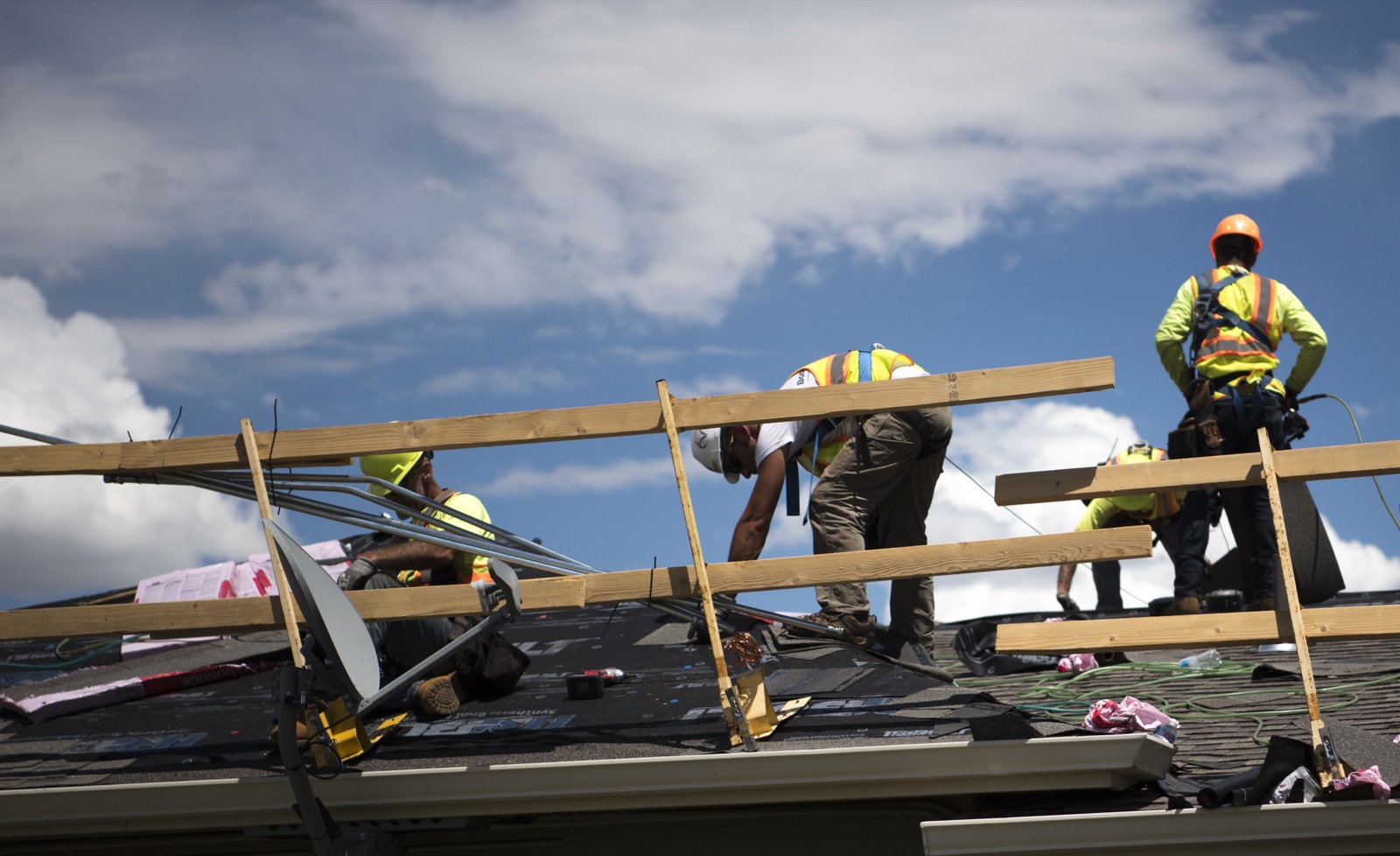
Hail can dent, crack or tear roof shingles and knock off the granules that protect them [1]. Nebraska's insurance department says lightweight shingles may show damage from 1-inch (quarter-size) hail, and heavier shingles from about 1 1/4-inch hail [2]. After a storm, stay off the roof, look for signs from the ground, take photos, and contact your insurer [3][4]. A local roofer can inspect the roof and give you a written estimate.
What hail damage looks like
In its hail testing, the Insurance Institute for Business & Home Safety (IBHS) sorts damage on asphalt shingles into three kinds [1]:
1. Dents or ridges that change the shape of the shingle. 2. Granule loss, where the gritty top layer is knocked off. 3. Tears, cracks or breaks in the shingle.
Hail leaves strike marks in a random pattern and in different sizes, according to the Nebraska Department of Insurance. If the marks form a pattern, hail probably didn't cause them [2]. A hit can also leave a bruise in the shingle mat that a roofer can usually feel by hand [2].
Not every mark leads to a leak. In IBHS tests, small dents let in very little water, while large dents and tears let in a lot more [5]. That is why an inspector looks at how bad each hit is, not just how many there are.
What size hail damages a roof
The National Weather Service calls hail severe once it reaches 1 inch across, about the size of a quarter [6]. That is also near the size where shingle damage often starts, though there is no single cutoff. Nebraska's insurance department says lightweight composite shingles may show damage from 1-inch hail, while heavy composite shingles need hail of about 1 1/4 inches (half-dollar size) [2]. An engineering table published by the roofing consultants' group IIBEC gives the same sizes for lightweight and heavier laminated shingles, assuming a roof in good shape and hail that hits straight on [21].
Smaller hail still matters over time. In IBHS lab tests, shingles hit by two rounds of small hail (under 1 inch) plus two years of outdoor weather became up to ten times more vulnerable to later large hail than new shingles. Small hail knocks off granules and leaves the asphalt open to the sun [7][22].
The shingle type, the roof's age and condition, and the angle of the hail all change how much damage a given storm does [21][22]. Large hail reports are most common in a band of the Great Plains, from Rapid City, South Dakota, to Denver, Dodge City, Kansas, and Springfield, Missouri, based on a NOAA Storm Prediction Center map of reports from 2003 to 2012 [8].
| Hail size (inches) | About the size of | Roof notes |
|---|---|---|
| 3/4 | Penny | Below the severe threshold [6] |
| 1 | Quarter | Severe threshold; lightweight shingles may show damage [6][2][21] |
| 1 1/4 | Half dollar | Heavier composite (laminated) shingles may show damage [6][2][21] |
| 1 3/4 | Golf ball | Well above the sizes Nebraska lists for shingle damage [6][2] |
How to check for damage from the ground
Stay off your roof. Climbing up is risky, and each time someone walks on a roof, more damage can occur [9]. You can learn a lot from the ground.
Mississippi's insurance department suggests these checks [9]:
1. Look at trees, shrubs and plants. If they were stripped of leaves, your roof may be damaged. 2. Check your car for dents and cracked glass. 3. Look for dents in patio covers, screens and soft aluminum roof vents.
The same Nebraska page adds that hail strong enough to damage a roof will also damage nearby cars, wood fences, shutters and siding [2]. You may see a lot of shingle granules at the end of your downspouts. That can be a sign of damage, but granule loss alone doesn't prove it [2].
Only the adjuster and the roofer you choose should go up on your roof [9].
What to do after a hail storm
1. Take photos and video once it's safe, from the ground. Colorado's Division of Insurance notes that many insurers let you send photos when you file [3][4]. 2. Contact your insurer or agent soon. Colorado regulators say to do it as soon as you can [3], and most insurers set a time limit for reporting a claim [10]. 3. Prevent more damage. Having a roofer cover a hole in the roof is a common temporary repair, and your policy may pay for temporary repairs, so keep every receipt [10][4]. 4. Hold off on big permanent repairs until the adjuster has seen the damage [11]. Don't throw away damaged items until your insurer says you can [4]. 5. Be there for the adjuster's visit so you can make sure they see everything [4]. 6. Get more than one repair estimate [4].
If your insurer's estimate is lower than a roofer's, Nebraska's insurance department suggests raising it with your adjuster, since the two may differ on materials or damage [2].
Will insurance pay for hail damage?
The Oklahoma Insurance Department says most standard homeowners insurance will cover hail damage to your roof [12]. But how much you get back depends on your policy, so read it or ask your agent.
Three things to check:
1. Your deductible. Colorado's Division of Insurance says many policies have wind and hail deductibles that are a percentage of your coverage, such as 1 percent, 2 percent or 5 percent [3]. On a home insured for $300,000, a 2 percent deductible means you pay the first $6,000. If the damage costs less than your deductible, the insurer won't pay [3]. 2. Cosmetic damage. Some policies don't pay for damage that only affects how the house looks, not how it works [12]. 3. How your roof is valued. Some policies pay the full cost of a new roof. Others pay less based on the roof's age and condition [13].
Our guide to whether insurance covers roof replacement explains each of these in more detail.
How much hail damage means a new roof?
There's no single number of hail hits that means a new roof. After the inspection, your insurer's adjuster estimates the repair cost and may recommend repair or replacement, based on the damage and your policy [2]. In Texas, the state insurance department notes that your company might not pay to replace the whole roof, even if new shingles won't match the old ones perfectly [13].
Roofers and engineers often call hail damage functional when it punctures or fractures a shingle in a way that hurts how it sheds water or shortens its life [22]. IBHS research shows that tears and large dents let water in [5], and that hail-worn shingles hold up worse in later storms [7].
Ask the roofer for a written report with photos and a line-by-line estimate. That gives you something concrete to compare with the adjuster's estimate.
Storm chasers and deductible promises
After a big hail storm, roofers often go door to door or start calling. Colorado's Division of Insurance tells homeowners to be careful with anyone who contacts them this way [14]. Mississippi's insurance department warns about out-of-town roofers who set up shop after a storm [9].
Be wary of any roofer who offers to cover your deductible. In Texas, it's a crime for a roofer to offer to waive your deductible or promise a rebate on it without the insurer's consent, with a fine of up to $2,000, up to 180 days in jail, or both [23][15]. Colorado law bars roofers paid from a home insurance claim from advertising or promising to pay, waive or rebate your deductible [16]. In Colorado, you can cancel a home roofing contract over $1,000 within 72 hours of signing [17]. If insurance is paying, you can also cancel within 72 hours of getting written notice that your claim was denied in whole or in part, with some limits for extra work found later [18]. This is general information, not legal advice.
A few more habits help no matter where you live:
1. Read anything before you sign it. You don't have to sign an assignment of benefits to get repairs done, and signing one hands your policy benefits to someone else [19]. 2. Never sign a contract with blank spaces [15]. 3. Don't pay in full up front, and don't make the final payment until the work is done [4].
Getting an inspection and quotes
A written inspection from a local roofer tells you what the hail did and what a fix would cost. With that in hand, you can compare it to your deductible and decide whether to file a claim.
You can request quotes from up to 3 local roofers through Matched Pros. Compare their reports and estimates side by side. Before you hire, check each roofer's license where your state or city requires one, and ask for proof of liability and workers' compensation insurance [9].
Questions
- Can you see hail damage on a roof from the ground?
- Sometimes. Plants stripped of leaves, and dents in cars, patio covers, screens, vents or wood fences, can all point to roof damage [9][2]. A bruise in a shingle may not show from below, so a roofer's inspection is the way to know for sure.
- Can small hail damage a roof?
- One storm of small hail may not do much. But in IBHS lab tests, two rounds of hail under 1 inch plus outdoor weathering made shingles up to ten times more vulnerable to later large hail [7].
- How long do I have to file a hail claim?
- It depends on your policy and your state. Most insurers set a time limit for reporting a claim [10], so report it as soon as you can [3]. If your policy pays replacement cost, it may also set a deadline to finish repairs. Nebraska's insurance department says that is usually 180 days, but your policy sets the actual time [2].
Related guides
Sources
- [1] Insurance Institute for Business & Home Safety (IBHS), Roof 101 (undated)
- [2] Nebraska Department of Insurance, Hail Damage: Does My Roof Need Repair? (undated)
- [3] Colorado Division of Insurance, Consumer Advisory: Division of Insurance Shares Tips After Hailstorm Batters Metro Denver (2024-05-31)
- [4] Texas Department of Insurance, After hail or windstorms (2025-12-09 (last updated))
- [5] Insurance Institute for Business & Home Safety (IBHS), Water Leakage Vulnerabilities for Shingles with Hail Damage (2019 (study))
- [6] National Weather Service, Cleveland office (NOAA), Submit a Spotter Report (hail size chart and severe criteria) (undated)
- [7] Insurance Institute for Business & Home Safety (IBHS), Impact Testing of High Concentrations of Small Hail (undated summary of a 2025 study)
- [8] NOAA Storm Prediction Center, SPC WCM Page (severe weather climatology) (undated (hail maps from 2003 to 2012 reports))
- [9] Mississippi Insurance Department, Weather Disaster Preparedness (undated)
- [10] National Association of Insurance Commissioners (NAIC), Navigating the Claims Process: Recover & Rebuild (2017-09-01 (modified 2024-01-16))
- [11] Insurance Information Institute (Triple-I), Settling insurance claims after a disaster (undated)
- [12] Oklahoma Insurance Department, Wind and Hail (undated (page copyright 2026))
- [13] Texas Department of Insurance, What to know about insurance and your roof (2026-03)
- [14] Colorado Division of Insurance, Consumer Advisory: Division of Insurance Shares Tips After Severe Hailstorm Pummels Eastern Colorado (2024-05-22)
- [15] Texas Department of Insurance, State law cracks down on roof scams (2019-08-07 (updated 2023-01-18))
- [16] Colorado General Assembly, Office of Legislative Legal Services, C.R.S. 6-22-105, Waiver of insurance deductible prohibited (Colorado Revised Statutes 2024, Title 6, Article 22) (2024 edition; section unchanged since SB 12-038 (2012))
- [17] Colorado General Assembly, Office of Legislative Legal Services, C.R.S. 6-22-103, Contracts for roofing services, writing required, required terms (Colorado Revised Statutes 2024, Title 6, Article 22) (2024 edition; section unchanged since SB 12-038 (2012))
- [18] Colorado General Assembly, Office of Legislative Legal Services, C.R.S. 6-22-104, Residential roofing contract, payment from insurance proceeds, right to rescind (Colorado Revised Statutes 2024, Title 6, Article 22) (2024 edition; section unchanged since SB 12-038 (2012))
- [19] National Association of Insurance Commissioners (NAIC), After the Storm, Read the Fine Print to Avoid Signing Away Your Insurance Benefits (2018-09-01 (modified 2024-01-16))
- [20] Insurance Institute for Business & Home Safety (IBHS), IBHS Tests Shingle Performance Against Hail, Shares Scorecard (2019-08-06)
- [21] International Institute of Building Enclosure Consultants (IIBEC); author Darrell L. Smith, PE, Asphalt Composition Shingle Damage: Hail or Manufacturing Defect? (Interface, Table 1, hail thresholds) (2013-02)
- [22] Insurance Institute for Business & Home Safety (IBHS) authors, Frontiers in Materials, Sub-severe hail: the missing piece in assessing asphalt shingle risk in North America (Frontiers in Materials 12:1603074) (2025-09-29)
- [23] Texas Legislature, Texas Business and Commerce Code Sec. 27.02, Goods or services paid for by insurance proceeds: payment of deductible required (as amended by H.B. 2102 (2019), eff. 2019-09-01; Class B penalty per Penal Code Sec. 12.22)
How we research and check our guides: editorial policy.